
5ERegulatory Requirements for Scott Islands Marine National Wildlife Area
Scott Islands marine National Wildlife Area
Scott Islands marine National Wildlife Area was established on June 27, 2018Footnote1. For more information on the establishment of this protected area and the associated regulations you may refer to the following publications, Canada Gazette, Part 2, Volume 152, Number 13: Scott Islands Protected Marine Area Establishment Order and Canada Gazette, Part 2, and Volume 152, Number 13: Scott Islands Protected Marine Area Regulations. The regulations themselves may be accessed at Scott Islands Protected Marine Area Regulations.
Coordinates
Scott Islands marine National Wildlife Area is located in Queen Charlotte Sound north of Vancouver Island, and includes parts of two marine bioregions, the Northern Shelf and the Offshore Pacific.
The described area contains approximately 11 546 square kilometers, except all islands and all foreshore lying above the low water line.
The boundaries of Scott Islands marine National Wildlife Area boundary extent are provided below as coordinates*.
|
Point |
Latitude (North) |
Longitude (West) |
|
1 |
50° 41’ 32.5” N |
128° 22’ 38.9” W |
|
2 |
50° 20’ 45.2” N |
128° 45’ 32.4” W |
|
3 |
50° 09’ 49.0” N |
129° 21’ 08.0” W |
|
4 |
50° 24’ 19.3” N |
130° 00’ 37.4” W |
|
5 |
51° 06’ 04.3” N |
130° 08’ 26.1” W |
|
6 |
51° 14’ 33.9” N |
128° 55’ 45.5” W |
|
7 |
51° 14’ 57.6” N |
128° 47’ 01.2” W |
|
8 |
51° 15’ 05.0” N |
128° 36’ 45.5” W |
|
9 |
50° 50’ 37.2” N |
128° 10’ 39.1” W |
|
10 |
50° 44’ 23.3” N |
128° 24’ 09.5” W |
|
11 |
50° 43’ 39.54” N |
128° 23’ 22.7” W |
Map of Scott Islands marine National Wildlife Area
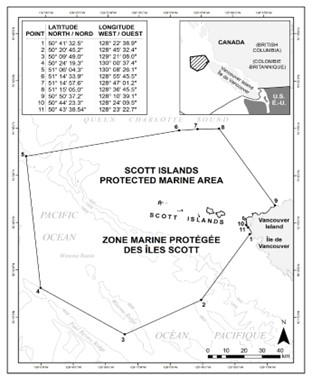
Map showing an area off the northwestern coast of Vancouver Island, British Columbia including the boundaries of Scott Islands marine National Wildlife Area. The marine National Wildlife Area follows a portion of the northwestern coast of Vancouver Island and extends out into the Pacific Ocean. One inset lists the latitude and longitude coordinates of the marine National Wildlife Area boundaries, and the second inset shows the location of the marine National wildlife Area in British Columbia in relation to the U.S.A. The scale on the map is in kilometers and is provided in this document for illustrative purposes only and may not reflect the reality on site.
Scott Islands marine National Wildlife Area Flight Restriction Zone extent is provided below as coordinates*.
|
Point |
Latitude (North) |
Longitude (West) |
|
1 |
50° 49’ 22.0” N |
128° 31’ 29.0” W |
|
2 |
50° 56’ 14.0” N |
129° 05’ 39.0” W |
|
3 |
50° 50’ 14.0” N |
129° 08’ 22.0” W |
|
4 |
50° 43’ 22.0” N |
128° 34’ 47.0” W |
Map of Scott Islands marine National Wildlife Area Flight Restriction Zone
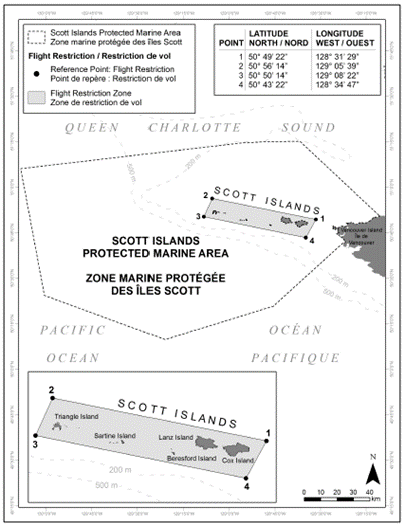
Map showing the Flight Restriction Zone and boundaries for Scott Islands marine National Wildlife Area. An inset lists the latitude and longitude coordinates of the Flight Restriction Zone within the marine National Wildlife Area. The scale on the map is in kilometers and is provided in this document for illustrative purposes only and may not reflect the reality on site.
The flight restriction zone applies to all aircraft, including drones (Unmanned Aerial Vehicles). Aeronautical charts are available from NavCanada for a fee. Drone pilots can use the interactive Drone Site Selection Tool to determine where drone flight is prohibited, restricted or potentially hazardous.
*All geographic coordinates (latitude and longitude) are expressed in the North American Datum 1983 (NAD83) Canadian Spatial Reference System (CSRS).
Prohibitions (Prohibited Activities):
Under the Canada Wildlife Act,
Scott Islands marine National Wildlife Area is protected and managed in accordance
with
Scott Islands Protected Marine Area
Regulations. The primary purpose of Scott
Islands marine National Wildlife Area is to conserve
migratory seabirds and species at risk as well as the habitats,
ecosystems, and marine resources that support them.
Site-specific regulations are in place year-round that prohibit
activities that may threaten the conservation of wildlife and
wildlife habitats in this area (e.g., noise and physical
disturbance caused by human activity, introduction of predators
such as rodents, etc.). The regulations provide exemptions to
the prohibitions in specific circumstances (see Exemption
Section below). Permits may be issued to carry out activities
that, although they may have an impact on the environment, have
been evaluated to be compatible with Scott Island marine
National Wildlife Area’s conservation objectives. Permits may
include terms and
conditions to minimize the impact of an activity on wildlife
and wildlife habitat. Transport Canada (TC) and Fisheries and
Oceans Canada (DFO) retain authority over shipping and fishing
through the
Canada Shipping Act, 2001 and
Fisheries Act, respectively.
The following prohibitions are in place in Scott Islands marine
National Wildlife Area:
a)Carrying out any activity that is likely to disturb,
damage or destroy wildlife or its habitat in the Protected
Marine Area or to remove wildlife or its habitat;
b)Dumping or discharging any waste material or substance
that is likely to harm wildlife or degrade the quality of
wildlife habitat;
c)Introducing any living organism that is likely to harm
wildlife or degrade the quality of wildlife habitat;
d)Flying an aircraftFootnote2 above the flight restriction zone
described in subsection (2) at an altitude that is below 3500
feet above mean sea level;
e)Being within 300 metres of the low water mark of the
Triangle, Sartine or Beresford Islands; or
f)Anchoring a vesselFootnote3 of more than 400 gross tonnes within one nautical mile (1852 metres) of the low water mark of the Triangle, Sartine or Beresford Islands.
At all times, it is your responsibility to comply with all relevant federal, provincial or territorial legislation. The Province of BC (BC Parks) is responsible for the designation, management and conservation of the Ecological Reserves and Provincial Parks within Scott Islands marine National Wildlife Area. BC Parks is responsible for enforcement matters related to Ecological Reserves and Provincial Parks under the Park Act and Park, Conservancy and Recreation Area Regulation, Ecological Reserve Act and Ecological Reserve Regulations. Related provincial legislation may apply (e.g. the BC Wildlife Act). There are fishing restrictions in place within Scott Islands marine National Wildlife Area; provincial and federal fishing regulations (e.g., Fisheries Act, Coastal Fisheries Protection Act, and associated regulations) should be reviewed for current restrictions and licencing requirements. Coastal Fisheries Protection Act, and associated regulations) for current restrictions and licencing requirements.
Exceptions
The federal regulations for Scott Islands marine National
Wildlife Area include various
exceptions to allow for certain activities, that would
otherwise contravene one or more of the prohibitions, to occur
without a permit issued under the regulations.
The following activities are exempt from all prohibitions ((a)
to (f)) as listed above:
-Activities carried out for the purpose of public safety or national security or in response to an emergency; or
-Activities of foreign vessels or aircraft within the exclusive economic zone (EEZ) of CanadaFootnote4.
The following activities are exempt from prohibitions (a) and (b) as listed above; all others still apply when conducting these activities:
-Fishing carried out in accordance with the Coastal Fisheries Protection Act and the Fisheries Act;
-Navigation of a vessel in accordance with the Canada Shipping Act, 2001; or
Navigation of military vessels, including foreign military
vessels or vessels that belong to, or are under the command of,
the Canadian Forces.
The following activities are exempt from prohibitions (d) and
(e) as listed above:
-A federal or provincial enforcement officer when they are performing their duties or functions or a person who is acting under their directions or control.
-An employee or officer of the government of British Columbia who, in the course of performing their duties or functions, is carrying out an activity for the purpose of wildlife research or the conservation or interpretation of wildlife, or a person who is acting under the direction or control of that employee or officer.
Permitting Requirements
Prohibited activities that are not already exempted and do not compromise the conservation objectives of Scott Islands marine National Wildlife Area may be permitted upon application. Refer to the Permits section of the regulations and the permitting guidance document, National Wildlife Areas designated under the Wildlife Area Regulations and protected marine areas designated under the Canada Wildlife Act: permitting guidance - Canada.ca. Depending on the type of activity, other federal or provincial permits or authorizations may be required to undertake an activity in Scott Islands marine National Wildlife Area. The Province of British Columbia (BC Parks) will continue to accept applications and make decisions on proposals within provincial protected area boundaries and separate authorizations may be required for the marine area (federal) and land (provincial). Contact your regional federal and provincial permitting office for more information on permit requirements.
More information on access and permitting for Scott Islands marine National Wildlife Area can be obtained by contacting the Environment and Climate Change Canada regional office.
General Guidance for Vessels and Aircraft in Scott Islands marine National Wildlife Area
Refer to
Guidelines to avoid disturbance to seabird and waterbird
colonies in Canada - Canada.ca for information about the impacts of disturbance
to seabirds and waterbird breeding colonies and guidelines to
avoid disturbance of colonies.
Many of the world's richest seabird colonies have been
destroyed by introduced predators. The following are important
biosecurity guidelines that should be considered to ensure that
no predators (e.g., rodents, including rats) are introduced to
Scott Islands marine National Wildlife Area:
•Visually inspect, pack and seal transported materials
against rodent intrusion. Ensure all concealed spaces and
compartments or voids are rodent-free;
•Store or transport materials in facilities or
containers known to be inaccessible to rodents;
•Inspect packed materials for rodent intrusion before
the last stage of transport; suspicious packages should be
re-inspected and re-packed.
•Never throw a rodent from a vessel or aircraft. They are good swimmers and will reach land.
Contact Information
Pacific Region
Environment and Climate
Change Canada
Canadian Wildlife
Service
5421 Robertson Road, RR#1,
Delta, British Columbia,
V4K 3N2
Telephone: 1 (250)
327-4101
Email: scfpacpermitscwspacpermits@ec.gc.ca
Authority: Environment and Climate Change Canada
Report a problem on this page
- Date modified: